
Experiences Before Stages - How to Build Out Your Customer Experience Journey
Build a stronger customer experience journey by defining experiences before stages. Learn the outside-in approach that creates positive moments at each step.
TL;DR
- When building a customer experience journey, define the experiences you want customers to have at each step before you name the stages, an approach credited to Rob Jeppsen, CEO of Xvoyant.
- Traditional funnel stages run awareness, education, selection, commitment, handoff, onboarding, utilization, expansion, and renewal; the experience-first method maps an emotional customer reaction to each.
- This "outside-in" thinking means designing processes, tools, and products around what is best for the customer and meets their needs, creating positive emotional moments along the journey.
I recently watched a video of Rob Jeppsen, CEO of Xvoyant, explaining how to take a different approach when building out your pre and post sales funnel stages. Many times the process of defining the pre and post sales stages is part of building out a customer journey map or strategy.
One of the key takeaways from Jeppsen’s approach is to define what you want the customer to experience along the journey before you define the stage names. Let’s dive into this a little deeper.
Traditional High-Level Funnel Pre and Post Sale Stages
Let’s start with a high-level simple example of stages. Traditionally, you might start with the following high-level stages (very simplified): awareness, education, selection, commitment, handoff, onboarding, utilization, expansion, and renewal. Below illustrates simple stages and actions.
The Traditional Way
Pre Sales
-
Awareness - Building awareness of your product or service.
-
Education - Educating the buyers and committee with solution selling.
-
Selection - Trying to get selected as the best solution to deliver solutions and business outcomes.
Sale Occurs
- Commitment - Signing the deal, celebration, and two way commitment towards success.
Post Sales (Customer Success)
-
Handoff - Transferring commitments, solutions, goals, and success criteria.
-
Onboarding - Onboarding the solution promised during the sales process.
-
Utilization - Utilization of the solution to deliver behavior change, business outcomes, and ROI.
-
Expansion - Unlocking new opportunities to further expand business impact
-
Renewal - Renewing the customer for another period of time
You might be tempted to start by writing the stages down like I have above. While that process is not bad, Jeppsen’s approach will help you take it to the next level.
Define the Experiences
Define the experiences you want your prospective clients and current clients to have during their customer journey. By starting with experiences versus stages, you are following the Jeppsen approach. Then you can define the stage to measure it in your CRM or customer success management platform.
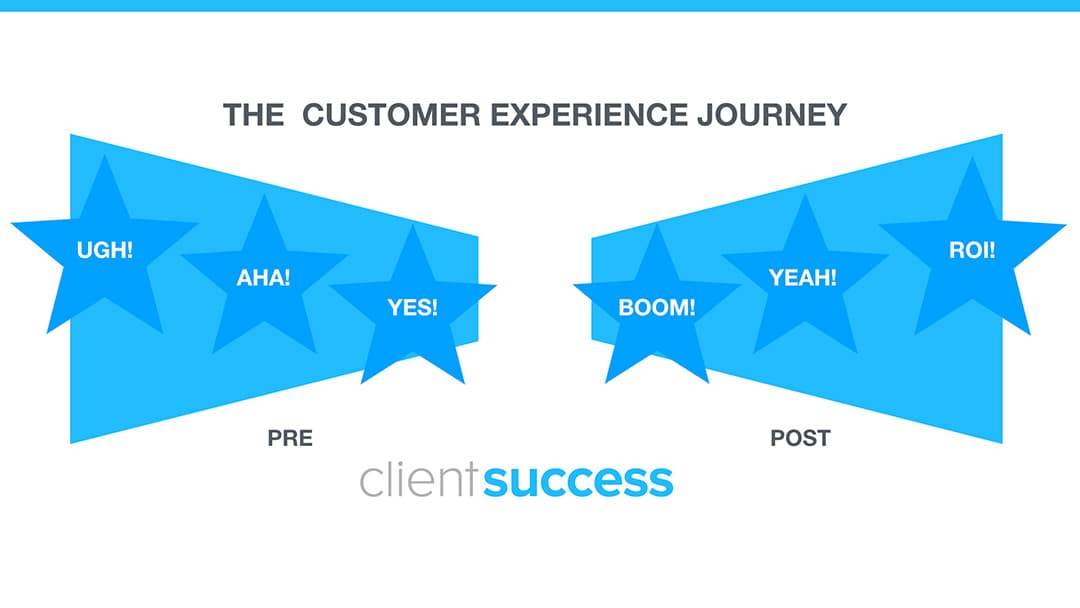
Below is an example of what we want prospective clients and current clients to say after they experience our company at every stage of the customer journey or funnel stages.
The Experience Way (Jeppsen’s Approach)
Pre Sales
-
Ugh! I’ve got a problem and it needs to be better—Awareness
-
Aha! There’s actually a solution that works—Education
-
This is the place! There are actually experts here—Selection
Sale Occurs
- Let’s do this! I’m committed to success from both sides—Commitment
Post Sales (Customer Success)
-
I’m in good hands! They clearly know what I want and need—Handoff
-
Boom! They did what they said they would do—Onboarding
-
Yeah! This is working—Utilization
-
Awesome! I’ve got to share with others—Expansion
-
ROI! I have tangible results and I’m excited to work with you again—Renewal
The goal of the Jeppsen approach is to help your company create emotional positive moments with your prospects and clients. To do this you will have to build experiences based on the your customer’s perspective. This is called outside-in thinking. Outside-in thinking means that you look at your business from the customer’s perspective and design processes, tools, and products on what is best for your customer and what meets your customer’s needs.
Check out our resources below for more customer success best practices and insights for how your organization can can ensure your product and customer success teams are fully synced:
eBooks:
Ultimate Guide to SaaS Customer Success Metrics
Customer Success as a Culture: Customer Success Leaders Edition
Blog Posts:
5 Best Practices to Build a Customer Success Journey Map
3 Ways to Build a Customer’s Perspective Journey Map
Learn more about how ClientSuccess can help your company develop a strong customer success methodology and strategy with easy-to-use customer success software by requesting a 30-minute demo.
Frequently Asked Questions
How do you build a customer experience journey?
What is outside-in thinking in customer experience?
See how ClientSuccess scales the playbook you've built.
Walk through it with a CS-led demo and see how it'd fit your team.