
The Four Fold Mission of Customer Success
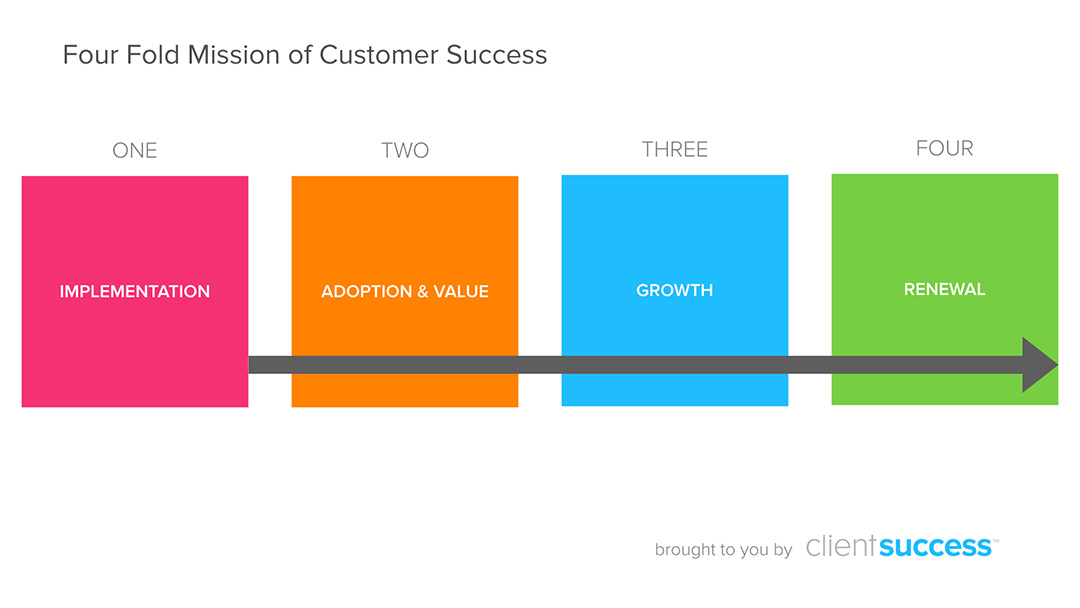
The four-fold mission of customer success maps to four milestones: implementation, adoption and value, growth, and renewal, and what CS teams own at each.
TL;DR
- The four-fold mission of customer success breaks the customer lifecycle into four milestones: implementation, adoption and value, growth, and closing or renewing.
- Implementation is the first time a customer works directly with your team outside of sales, making it one of the most important stages of the entire lifecycle.
- To earn recurring revenue you must deliver recurring value; growing adoption and value opens the door to expansion revenue, and hitting all three earlier milestones makes renewal nearly automatic.
Customer success is a strategic and vital part of any organization that spans multiple departments and people. For customers, their lifecycle with your organization begins when they receive that first marketing email and it (hopefully) won’t end for a long, long time. The customer/organizational relationship is usually quite long, and every single interaction influences its health. While customer success as a whole can be comprised of a complex series of events, relationships, and decisions, the mission of customer success can be boiled down to four strong milestones.
Four Fold Mission of Customer Success
1. Implementation
The first stage of any new customer relationship is the kick off or implementation process. A customer has decided to buy your product and is ready to get started. This can actually be one of the most important stages of your entire customer lifecycle because it is the first time your new customer has worked directly with your team outside of the sales process.
Here are some ways to make sure that your team and your new customer hit the ground running:
- Understand exactly why they purchased your product. What are some quick wins your team can knock off early in the implementation process? What are possible risks?
- Know right off the bat what your new customer expects from your team. Will you need to be available to answer emails late at night? What are the best days of the week for a recurring meeting?
- Realize where roadblocks might occur down the road. The sooner your team can identify potential roadblocks on both sides means the sooner you can begin to strategize a plan to overcome them.
2. Adoption & Value
Now that your customer is up and running with your product, it’s time for them to start realizing value. To achieve recurring revenue, you need to deliver recurring value. How do you know if a customer is feeling comfortable with your product? Ask them!
Having clear, honest conversations with your customers is key to making sure they provide you with feedback (and success stories!) in the future. You can also take the insider route and gauge whether or not your customers are actually using your platform. It’s not enough to just have an administrator or team lead logging in a couple times a week. It’s imperative for customer success teams to monitor customer adoption in the first few weeks and months of a new implementation to make sure customers are not falling off the wagon early. Keep your eyes open for common on-boarding issues, such as:
- End users don’t fully understand how to use the product or service
- The product that was implemented is not the same as what was sold
- There is a clear lack of educational materials, documentation, or training offerings
- Hands-on help isn’t available to end users
Once customer adoption grows, then true value begins to emerge. This is when your team can ask your successful customer to participate in a success story. You don’t want to scare your customer off, so it’s important to tread lightly and casually. Make this a repeatable process that all customers go through for maximum success.
3. Growth
Growing adoption and unlocking value for your customers opens the door to growth. Adding new users, new product offerings, or new features is where customer success organizations can begin to attach an ROI to their efforts. The key here is for your customer success team to uncover the value in your product and then transform that value into dollars.
Set expectations early on. When your team knows what they are responsible for and your customer knows what they are responsible for, projects can move quickly and efficiently. Furthermore, if your team can deliver on projects ahead of a deadline, it’s a sign that you prioritized your unique customer relationship. Ask for customer feedback and act on it. This is key. Customers are on the front lines of your products. They know what’s working and what isn’t. Opening up these direct communication channels is key to improving customer relationships. The more customers trust you and your organization, they more they will invest in your product.
The growth milestone of the customer success mission is one of the most important strategies. As your customers unlock value, you unlock pathways to new departments, more users, and new product sells. Expansion revenue is key to drive SaaS profitability and big time growth.
4. Closing or Renewing
If all three milestones above are met, a renewal is imminent. If for some reason you miss one of the above steps, closing a deal requires re-selling the value, and for customers who have seen everything, this can prove to be very difficult. If your team does find itself facing a particularly difficult renewal conversation, don’t worry! There areplenty of ways to open up conversation with conflicted customers:
- Ask what made them decide to partner with your organization in the first place.
- Try to determine as a group where things might have fallen off the rails.
- See if your customer ever referred your company to others. Why did they do this?
Opening up an unbridled dialogue with customers shows them that you are dedicated to their partnership and are determined to do whatever it takes to salvage their relationship.
Looking at customer success as four-fold mission allows customer success leaders and managers to clearly segment out activities and decisions to reach the end goal: renewal. Check out our resources below for more customer success best practices and insights for how your organization can approach customer success with the customer at the center:
eBooks:
5 Ways to Surprise & Delight Your Customers
Customer Success as a Culture: Customer Success Leaders Edition
Blog Posts:
3 Keys to Restoring Customer Confidence
6 Listening Techniques of Great Customer Success Leaders
Learn more about how ClientSuccess can help your company develop a strong Customer Success methodology and strategy with easy-to-use customer success software by requesting a 30-minute demo.



Frequently Asked Questions
What is the four-fold mission of customer success?
Why is implementation so important in customer success?
How do adoption and value lead to growth?
See how ClientSuccess scales the playbook you've built.
Walk through it with a CS-led demo and see how it'd fit your team.